Selasa (22.03.2011)
PREPARATION FOR MICROTEACHING

Khamis (24.03.2011)
Selasa (22.03.2011)
PREPARATION FOR MICROTEACHING
Khamis (24.03.2011)
Selasa (15.03.2011)
Berikut merupakan hasil pembelajaran kami pada hari tersebut :
Field trip
What is a Field Trip and Why Take Them?
A field trip is defined as any teaching and learning excursion outside of the classroom.
There are two types of field trips – Physical and Virtual.
Physical Field Trip Examples
Virtual Field Trip Examples
Why Field Trips?
How to Plan and Run a Successful Physical Field Trip
Guidelines for Safety and Behaviour
Demonstration
What is it? VERBAL EXPLANATION + LIVE DISPLAY USING APPARATUS/MODELS = DEMONSTRATION

PURPOSE OF DEMONSTRATION
ADVANTAGES
Khamis (17.03.2011)
LESSON PLANNING
What is a Daily Lesson Plan(DLP)?
Selasa (08.03.2011)
Berikut merupakan hasil pembelajaran kami pada hari tersebut :
Discrepant event
A discrepant event is an event that surprises, startles, puzzles, or astonishes the observer. Often, a discrepant event is one that does not appear to follow basic rules or principles of matter and energy. The outcome of a discrepant event is often unexpected or contrary to what one would have predicted. The explanation for the phenomena observed is not often easily explained without further investigation. Discrepant events stimulate an observer’s natural curiosity. After observing a discrepant event, an observer will want to know “why!” The observer will be strongly motivated to “find out.” Discrepant events engage the observer in the learning process. Discrepant events engage learners in inquiry.
Discrepant events can be used:
to engage students in inquiry as a demonstration followed by discussion to introduce a new topic to engage students in science processes skills as a small group lab activity as a mind-on warm-up to stimulate critical thinking as a take home lab activity as a challenge for students to create investigative lab activites to find out more about the event
example of discrepant event :
Alcohol and water miscibility
If you add 50 mL of water to 50 mL of water, you get 100 mL of water. If you add 50 mL of ethanol to 50 mL of ethanol, you get 100 mL of ethanol. What happens if you mix 50 mL of water with 50 mL of ethanol? Actually, you get about 96 mL of liquid.
Why?
The water and ethanol molecules are different sizes, with the ethanol molecules being smaller. Some of the ethanol fits in the spaces between the water molecules.
Think about two other materials: a liter of sand and a liter of rocks. If you pour the sand into the rocks, the total volume will be less than two liters, because some of the sand fills in the spaces between the rocks.
Khamis (10.03.2011)
Berikut merupakan hasil pembelajaran kami pada hari tersebut :
Lecture Method
Jigsaw in 10 Easy Steps
The jigsaw classrom is very simple to use. If you’re a teacher, just follow these steps:
Role-playing method
One of the most common training methods in use is called Role Play. Role Play is used in a variety of ways:
a) A small group enacts a role-play about a situation while other learners observe. A discussion follows that enactment. In this use, it is similar to a demonstration where learning occurs through observation. Such role-play can be enacted by the trainers themselves, a few outsiders, or a handful of learners, with or without trainers.
b) Secondly, role-play is used to stimulate discussion on complex issues. A brief enactment by trainers or learners or both can be used to stimulate further group discussion on similar issuer and experiences that learners share. This method of learning is essentially group discussion where role-play merely acts as a stimulant or catalyst for the discussion that follows. In this use, it is similar to an aid like charts, video clipping, etc.
c) In certain situations, a role-play is also used to practice some skills. For example. The adult education instructor can be trained to practice how to motivate adult learners by enacting different roles. The prime method of learning here is by practicing and receiving feedback from learners and trainers after that practice.
d) In the fourth way, a role-play is a re-enactment of past experiences. In this sense, all learners are involved to enact an issue or a situation about which they are familiar in their past. For example, a group of 25 illiterate women learners can be divided into 5 sub-groups to prepare and re-enact the experience of being a wife in the family. Since all the learners share this experience and all of them are involved in re-enactment, learning occurs here through the twin steps of preparation and re-enactment.
This approach is particularly useful where learners share a somewhat similar experience and that experience or issue is difficult to recall because of its emotional valence. It can also be used where the possibility of recall of past experience is likely to be uneven among learners. This use of re-enactment as role-play is particularly apt for issues dealing with complex emotional and attitudinal aspects of learning.
Obviously, the choice of a particular use of role-play depends on the learning agenda, group of learners and trainer’s capacity. But it is important to remember that the fourth type of use mentioned above implies learning from re-enactment of past experience, which can be a powerful method if the focus of learning is awareness.
Of course, in whichever way role-play is used, a discussion must follow to process the experience of either observation or re-enactment. It must be remembered that real consolidation of learning through role-play occurs through the steps of preparation, re-enactment, discussion, processing and analysis with generalization to real life situation.
Advantages:
• It is energizing
• It helps the suppressed and illiterate to express their feelings
• It is simple and low cost
• It focuses on problems which are very real in nature
• It presents complex issues simply and in a short while
• It does not need material or advance preparation
Disadvantages:
• There is a possibility of it becoming entertainment which vitiates learning
• Participants can get too involved in their roles and later loose objectivity during analysis
• Acting can become an end in itself and participants can overact or distort the roles
• That the observers need to observe must be explained clearly or else the discussion, which occurs later on the basis of this observation, will be inadequate.
At the end of role-playing:
Role-plays can become charged with emotion. Bringing people ‘out’ of their roles is of paramount importance, otherwise negative or hostile feelings may persist, causing continued discomfort and anxiety. Techniques for doing this include:
• Engaging in discussion of a totally unrelated topic to promote interaction that brings the group back to the ‘here and now’
• Allowing further discussion of any issue of concern
• Allowing objective feedback on aspects of the portrayal of the roles and how real the situation felt
• Asking actors and observers what they liked about the interaction and what might have been done differently
• Asking the class what they learnt from the role-play
• Drawing the class’ attention back to the objective, or to the main points that the role-play was to demonstrate.
Selasa (01.03.2011)
LABORATORY WORK 3

Khamis (03.03.2011)
Berikut merupakan hasil pembelajaran kami pada hari tersebut :
Practical Work in Science
– enhance scientific, manipulative and thinking skills
– positive attitude towards science
– development of scientific concepts
– deductive / verification
– inductive
– problem solving
Selasa (22.02.2011)
LABORATORY WORK 1

Khamis (24.02.2011)
LABORATORY WORK 2

Selasa (15.02.2011)

Khamis (17.02.2011)
Berikut merupakan hasil pembelajaran kami pada hari tersebut :
Science, Technology and Society
Science is defined as knowledge of general truths. It may also refer to a skilled technique, technology or practice. Science utilizes the scientific method in order to prove its general truths.
Technology is the application or usage of knowledge in a particular area. It can also be a specialized field.
A Society is a collection of relationships between individuals, including different economic, cultural, or political properties with a common end or goal; it can be a community and also a social group or organization.
When these three things are combined, it is learned that science technology and society is the application of a skilled technique or a general truth and how it affects our society and vice versa. Science and technology has impacted our society in such a large number of ways that its evidence is everywhere. Just think of the telephone, ever since it was invented society desired a more mobile way to communicate with people, hence the invention of the mobile phone.
The same can be said about the mail, as now there are more emails sent in one day than there are articles of mail sent via the post office in one year. The effects that science & technology have on society can be both intended and unintended, and both outcomes can be equally important.
Some of these effects are as follows: Values are changed because expectations and reality are changed. Some state that Ethics are also affected, in cases such as capitol punishment, abortion and euthanasia that have arrived due to technology and/or science. Technology is also said to simplify people’s lifestyles by which it is easier to gain information via the internet, attend classes via kallianceand more specialized jobs being created to support the new inventions.
Science technology and society is more than just the sum of its parts. It is our way of life. Society demands products and inventors must create them in order to appease us. And because the growth of technology tends to create more jobs, the need for certified professionals is vast. Certification can be obtained in many different forms of which e-learning is one.
The key goals of STS are:
Mastery learning
Selasa (07.02.2010)
Berikut merupakan hasil pembelajaran kami pada hari tersebut:
THINKING SKILLS

PROCESS SKILLS AND THINKING SKILLS


Khamis (10.02.2011)
Berikut merupakan hasil pembelajaran kami pada hari tersebut:
Teaching Approaches
Basically, teaching of science can be divided to two basic approaches; namely the inductive and deductive approach. The inductive approach provides students with learning situations in which they can discover a concept or principles. In deductive approach on the other hand, a concept or principle is given and discussed, followed by experiences to further illustrate the idea presented.

Inquiry learning
‘ teachers presenting information’ to ‘ students learning sc themselves’ through active involvement
– skills of asking questions
– planning an investigation
– gathering data
– using appropriate tools
– explaining relationship
– communicating the results
– originating the problem
– formulating hypothesis
– designing investigative approach
– conducting experiments
– synthesising knowledge
Constructivism
Constructivism is a view of learning based on the belief that knowledge isn’t a thing that can be simply given by the teacher at the front of the room to students in their desks. Rather, knowledge is constructed by learners through an active, mental process of development; learners are the builders and creators of meaning and knowledge. Constructivism draws on the develomental work of Piaget (1977) and Kelly (1991). Twomey Fosnot (1989) defines constructivism by reference to four principles: learning, in an important way, depends on what we already know; new ideas occur as we adapt and change our old ideas; learning involves inventing ideas rather than mechanically accumulating facts; meaningful learning occurs through rethinking old ideas and coming to new conclusions about new ideas which conflict with our old ideas. A productive, constructivist classroom, then, consists of learner-centered, active instruction. In such a classroom, the teacher provides students with experiences that allow them to hypothesize, predict, manipulate objects, pose questions, research, investigate, imagine, and invent. The teacher’s role is to facilitate this process.
Piaget (1977) asserts that learning occurs by an active construction of meaning, rather than by passive recipience. He explains that when we, as learners, encounter an experience or a situation that conflicts with our current way of thinking, a state of disequilibrium or imbalance is created. We must then alter our thinking to restore equilibrium or balance. To do this, we make sense of the new information by associating it with what we already know, that is, by attempting to assimilate it into our existing knowledge. When we are unable to do this, we accommodate the new information to our old way of thinking by restructuring our present knowledge to a higher level of thinking.
Similar to this is Kelly’s theory of personal constructs (Kelly, 1991). Kelly proposes that we look at the world through mental constructs or patterns which we create. We develop ways of construing or understanding the world based on our experiences. When we encounter a new experience, we attempt to fit these patterns over the new experience. For example, we know from experience that when we see a red traffic light, we are supposed to stop. The point is that we create our own ways of seeing the world in which we live; the world does not create them for us.
Constructivist beliefs have recently been applied to teaching and learning in the classroom.
Contextual learning
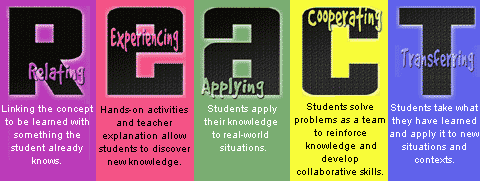
Contextual Learning is reality-based, outside-of-the-classroom experience, within a specific context which serves as a catalyst for students to utilize their disciplinary knowledge, and which presents a forum for further formation of their personal values, faith, and professional development. Beyond the challenge of direct, meaningful experience, contextual learning requires reflection to build lasting cognitive connections. Contextual learning is useful for child development as by providing learning experiences in a context in which the are interested and motivated in they are able to achieve more. Contextual learning structures may include internships, service learning, and study abroad programs, among others.” This definition was formulated in 2002 and presented at the annual conference proceedings of the National Society for Experiential Education by Michael True.
Selasa (25.01.2011)
Berikut merupakan hasil pembelajaran kami pada hari tersebut :
Science Process Skills
Basic Skills
Integrated Science Process Skills
Observation

Khamis (27.01.2011)
Berikut merupakan hasil pembelajaran kami pada hari tersebut :
Measuring and Using Numbers
Classifying
Inferring

Examples …
Predicting
Communicating
Using Space-Time Relationship
Interpreting Data
Defining Operationally
a. the number of hours a could stay awake
b. the distance a person could run without stopping
c. the number of jumping jacks a person could do
Examples
Controlling Variables
Hypothesising
Experimenting
Manipulative Skills
Selasa (18.01.2011)
Hasil pembelajaran kami pada hari tersebut adalah seperti berikut :
-Behaviourisme melihat kepada ‘product’ iaitu perubahan sikap para pelajar selepas menjalani proses pembelajaran.
-Constructivism melihat kepada ‘process’ iatu bagaimana seseorang itu belajar untuk memahami sesuatu konsep.

 SCIENTIFIC KNOWLEDGE
Eg. “wires of different thickness have different electrical resistance”
Eg. A force is given to an object in motion because force is determined by the mass of the object and the acceleration (speed and direction) with which it moves.
eg: Hot air expand, Archimedes principle
eg: Law of conservation of energy
eg: quantum theory
Teaching Concepts
Giving examples and non-examples
The use of advance organizer such as concept maps
The use of images and analogies
The use of various presentation such as models and symbols
The use of experiments
Khamis (20.01.2011)

Selasa (11.01.2011)
Berikut merupakan hasil perbincangan kami di dalam kelas pada hari tersebut :
Science Education
Science education empowers students to be questioning, reflective and critical thinkers. it does this by giving them particular ways of looking at the world and by emphasizing the importance of evidence in forming conclusions. Science education develops students’ confidence to initiate and manage change to meet personal, vocational and societal needs. Science education assissts students to be active citizens by providing and understandings they need to be informed contributors to debates about sensitive, moral ethical and environmental issues. An appreciation of scientific knowledge, processes and values has the potential to help students appreciate and ecologically-sustainable environment. It is important that the students appreciate and understand how the study of science presents them with opportunities for responsible decision making in their local, national and global communities.
Guidance for Science Curriculum Development :
1. Rukun Negara :
2. National Philosophy of Education :
“Education in Malaysia is an on-going efforts towards further developing the potential of individuals in a holistic and integrated manner, so as to produce individuals who are intellectually, spiritually, emotionally and physically balanced and harmonic, based on a firm belief in and devotion to God. Such an effort is designed to produce Malaysian citizens who are knowledgeable and competent, who possess high moral standards and who are responsible and capable of achieving high level of personal well-being as well as being able to contribute to the harmony and betterment of the family, the society and the nation at large”
3. National Science Education Philosophy :
In consonance with the National Education Philosophy, science education in Malaysia nurtures a Science and Technology Culture by focusing on the development of individuals who are competitive, dynamic, robust and resilient and able to master scientific knowledge and technological competency.
Science and technology culture can be achieved by the followings steps :
1. Science as a product knowledge.
2. Science as a process skills.
3. Application of the scientific knowledge in daily life.
4. Attitude and Values
5. Teaching and learning strategies.
6. Usage of ICT
7. Integration with the other non-science subjects such as engaging language in science education e.x. PPSMI.
In conclusion, science education can be potrayed as below :
Khamis (13.01.2011)
Berikut merupakan hasil perbincangan kami di dalam kelas pada hari tersebut :
Behaviourism
Cognitivism
Robert Gagne and the General Learning Hierarchy
Level 8 : Problem solving
Level 7 : Principle learning
Level 6 : Concept learning
Level 5 : Multiple discrimination
Level 4 : Verbal association
Level 3 : Chaining
Level 2 : Stimulus-respon
Level 1 : Signal learning
Piaget’s Stages of cognitive development
Vygotsky’s Zone of Proximal Development


